

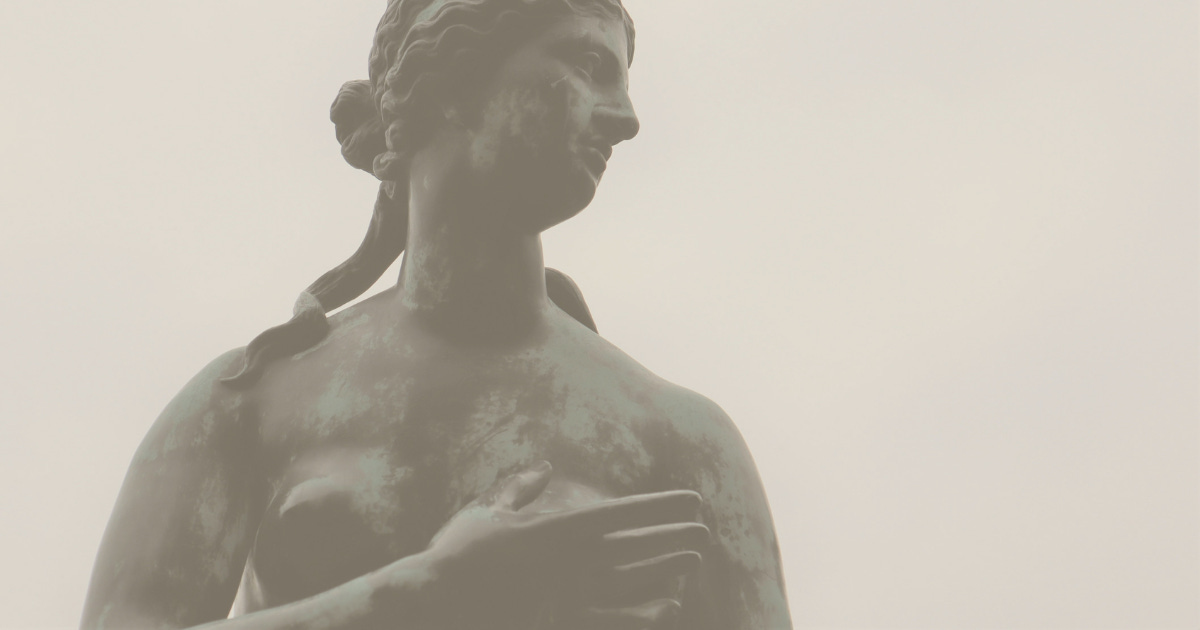
The feminine—within bodies of all kinds—is missing from this world en masse.
She has gone cold and numb—silently disappearing under the extraction and distortion of her many gifts.
Her wild, erotic pleasure tamed into performance and transaction.
Her ability to awaken magic and mythic awareness traded for cheap dopamine.
Her tenderness, slowness, and sensitivity mistaken for weakness; her receptivity cast as theft.
She blooms with indescribable softness where there is steady, non-reactive space for her weather: grief as full and deep as her ecstasy—both products of her unconditional love.
She is a portal to intimacy with life.
Emerging only when she senses reverence for—not attempted ownership or control of—her beauty and offerings, she rests beneath sleepy laurels, curled inside a tightly sealed bud, waiting for the conditions to be right. Much like the Earth, she would abundantly nourish and bless her surroundings if given the care she needed to thrive. Instead, she is often a receptacle for abuse, holding what she was never meant to carry.
Her grief is not excess, nor is it indulgent or self-victimizing—it is macrocosmic and proportionate to her care.
~
There are no words for the pain of the feminine awakening to the reality of a planet on fire. Everything is too fast; too loud; too sharp. How can one be intimate with this blistering corruption? How can one’s heart remain open in it? It is much easier, of course, to go back into performance: to turn off—to close up—disappear.
The only way to sustain her tenderness without self-destruction is to build a sanctuary—a garden of Eden—with walls strong enough to hold her.
This desire is a necessary and inevitable longing for the masculine in his mature form—the one who builds castle walls instead of cages: a sacred force of protection without possession.
The exact depth of her waters must correlate to the strength and stability of the chalice that contains them. Where are these walls? Where does a true sanctuary for the feminine exist? I have willingly trapped myself inside of many different forms and containers—jobs, relationships, community, identities—searching wearily for relief, to no avail: too many have been either a prison or an amplification of pain.
So, now I seek to build my own. Only I am not as skilled in the ways of the masculine, and I am learning. Sometimes, out of desperation, I have a mad idea that I will trade the safety of my feminine for some fleeting, normalized form of comfort—that I will find solace in a corporate structure, for instance—but I know that is not what my personal garden looks like. I know it will be too fast; too loud; too sharp—that I will inevitably lose the depths of my feminine to such an environment. She will close and shrivel and disappear.
Let me be clear: sanctuary is a precondition for the feminine’s highest contribution—not escape. I am not interested in fleeing from the world, but rather to finally meet it without self-erasure.
I can no longer pretend that sanctuary is elsewhere: I can no longer consciously and unconsciously search for it in the world. I know it must be embedded in my own flesh, breath, and personal edges.
With the turning of a new year, under the first full moon, I turn to the forces of the invisible world that the feminine so deeply knows how to commune with, and I have asked for their assistance in helping me disappear in a different way. Not to fade from life. Nor to struggle between forcing myself into “safe” spaces where I don’t belong and braving the fire uninsulated (a struggle that eventually leads to collapse)—but to find such a permanent and enduring hidden sanctuary within myself that it cannot help but manifest in my waking life.
~
One day soon, I will wake up in my garden—my own sacred space where I will birth art and protect my pleasure—where beauty and joy will safely flourish. A place—inner and outer—that I can share with my future children… where they will be able to blossom… wild, free, and unburdened.
Until then, I’m learning to rest and enjoy life while my inner vision merges with form… until I arrive in Eden.
amazingly sensitive writing